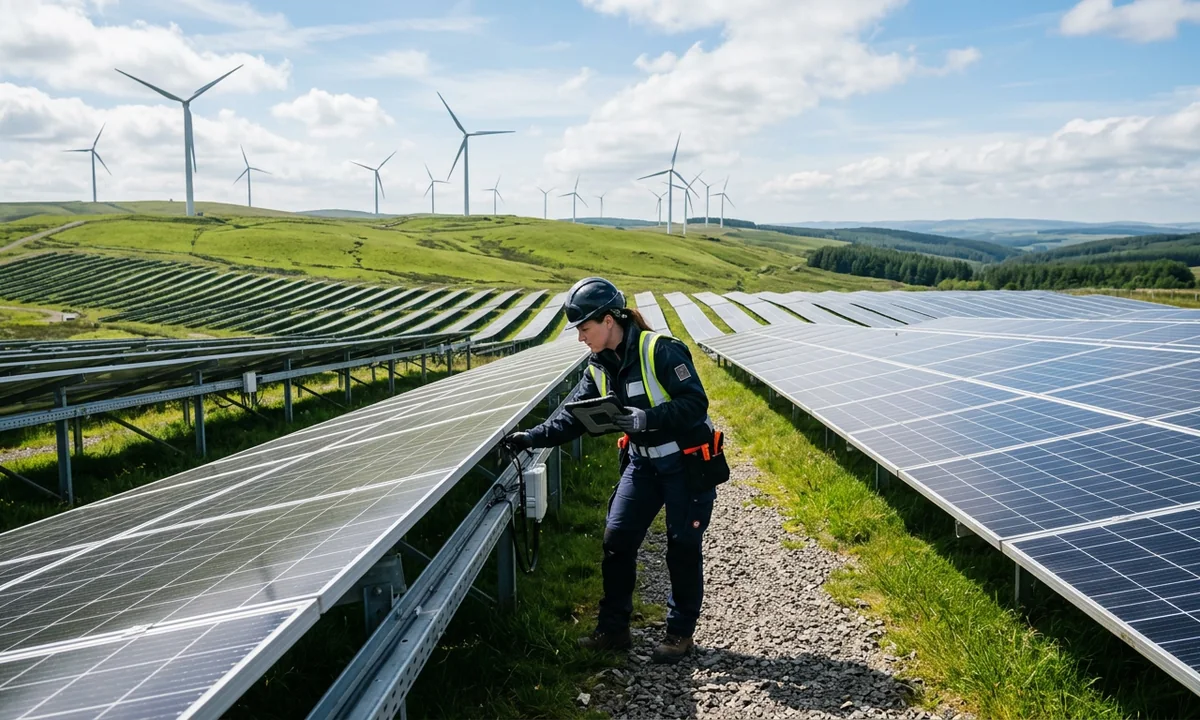
AI-enabled operational improvement for clean energy and sustainability teams.
Energy and sustainability initiatives often stall because data, reporting, and operating routines are scattered. AICG helps teams organize the workflow before scaling the technology — so the reporting is trustworthy and the effort is sustainable.
Energy and sustainability teams are asked to do something hard: produce accurate, auditable numbers — emissions, energy use, asset performance — from data spread across meters, spreadsheets, vendors, and facility systems. The reporting burden grows every year, and much of it is assembled manually under deadline pressure. That is slow, hard to audit, and easy to get wrong.
AICG helps teams turn that scramble into a dependable workflow. We focus first on the highest-value report or analysis, organize its data sources and review steps, then automate the repetitive assembly while keeping people in control of what is published. Our enterprise background means we treat auditability and governance as first-class requirements, not afterthoughts.
Use cases
Where applied intelligence can help.
Energy forecasting & variance — forecast usage and explain variance against baselines.
Asset performance reporting — maintenance and performance summaries from operational data.
Emissions & ESG dashboards — compliance and sustainability reporting leaders can trust.
Evidence automation — automated collection of operational documentation and proof.
Efficiency workflows — workflow design for facility energy-efficiency initiatives.
Reporting governance — AI governance for sustainability and disclosure use cases.
Funding programs to watch
Funding-aware project framing.
NRCan Smart Renewables and Electrification Pathways Program
NRCan Green Industrial Facilities and Manufacturing Program
Ontario emissions and clean-technology programs
Industrial energy-efficiency and decarbonization support streams
Program names are directional research signals, not eligibility advice or approval guarantees.
What a first engagement looks like.
We choose one report or analysis that consumes disproportionate effort — often an emissions or energy report — and trace every input back to its source. We document where numbers come from, who reviews them, and where errors creep in, then build an automation that assembles a defensible draft for human sign-off.
The result is faster cycle time, fewer manual errors, and a reporting process you can actually audit. From there, we help you decide which additional reports or sites justify the same treatment, with clear ROI and governance for each step.
How AICG helps
Turn ambition into a scoped, measurable pilot.
Define practical AI use cases for energy and sustainability work
Create reporting systems leaders can trust
Build project scopes with clear technical milestones
Reduce manual reporting effort while improving auditability
Clean energy & sustainability AI: common questions.
Where do these teams get the most value from AI?
Usually in reporting and evidence collection: emissions and ESG reporting, energy variance analysis, and automated gathering of operational documentation that is otherwise assembled by hand.
Our energy and emissions data is scattered. Is that a blocker?
No — it is the starting point. We organize the workflow and data for one reporting use case first, which is faster and cheaper than launching a large platform before the process is clear.
Can AICG improve the trustworthiness of sustainability reporting?
Yes. We build reporting workflows with clear sources, human review, and auditability so leaders and external stakeholders can trust the numbers.
Do you account for governance on sustainability use cases?
Governance is built in: data sources, review gates, and guardrails are part of the implementation, which matters when reports are used for compliance or disclosure.
Start with one report.
The strongest sustainability pilots begin with a single emissions or energy report where the team can compare assembly time, error rate, and auditability before and after — with every number traceable to its source.